February 15, 2013

What does the Perfect Pilot Accomplish?

Before we dig in to a series of pilot episode reviews, let’s take a look at the criteria for a perfect first episode.

Exposition:

“Don't you just hate exposition?” is a line (from Charmed) that really stuck with me, probably because it struck me in the heart and the wound just won’t heal. What do you mean, you hate exposition? Hate bad exposition, not the backstory-telling itself!

Even when you’re not looking for the exposition, bad story-telling will hit you over the head and ruin the show, and the pilot episode is where this is most likely to happen.

Too many dialogues between characters that don’t really need to talk about said backstory; speeches that are clearly only for the audience’s benefit; flashbacks with voiceovers; and any over-zealous narration, really, immediately kills what could have otherwise been a good pilot. It’s a lot to ask for a writer/director to come up with new and exciting ways to tell us the backstory, but the best rule of thumb is to just let it happen slowly. We don’t need to know very much about our characters and their world in the very premiere. 

I, and most audience members like me, would much rather be left in the dark, than spoon-fed. It insults our intelligence.

Introduction to the Series:

For me, there is a difference between the exposition and the introduction, particularly 
in a television pilot, where the viewer is likely to sit to the end, but whether he or she watches anything beyond that first episode is entirely determined in that approximately 60 minutes. The unaired pilot of Stark Trek, for example, lets the viewer know what kinds of, pardon the language, crazy shit is going to happen in this series in a time when space operas on television were pretty revolutionary. The aliens with the big heads in Star Trek’s pilot, The Cage, really tell the audience a clear message: If you think this is cool, watch on. If this is a little weird for you, go back to M*A*S*H.


The conflict:

If the conflict is resolved by the end, I have no reason to watch the second episode. It may sound obvious, and may be inspiring of far too many extraneous cliff-hangers, but keep this in mind: if all of the conflicts are resolved, it means, inherently, that the show will be episodic. I have little problem with episodic shows, save that I can’t re-watch a single episode of House (for some reason all of the details stick with me, removing any enjoyable tension from a re-watch), but really, why tune in next week unless I’m worried about the state of the story world? If the protagonist is already near completion of his or her quest, I’m bored now. I came out to see a fight!

I will find examples of this in pilots, for example Doctor Who almost fell prey to a resolved conflict, but for a few examples I will largely say that early Angel and late Buffy suffered from some very boring episodic episodes that ended with no movement forward.

At first I found myself wondering why Angel needed a spin-off if all he was going to do is roam LA saving one victim at a time with no character development and no arching plot. Boring! The show did not pick up for me at all until Darla… happens... in Season 2. Buffy lost me at a crucial moment in Season 6 where, despite Season 5 being the absolute climax of a show that would air another 2 years, the story stopped suddenly.

In fact, Lost did the same thing for me mid-season when I just wanted the freaking hatch to be opened already.

If all of the plot strings are tied into a tight, artfully tied bow, the audience gets very bored. Even if we must defeat the first of many evils, solve the first of many crimes, complete the first of many quests, leave just one conflict open for me, please.

The characters:

There had better be a character I love, and a character I hate, if you want me to keep watching. Although I didn’t love the premiere of Once Upon a Time, I loved Emma and hated Regina the evil Queen.

Remember the Firefly pilot? If you remember clearly enough to your first viewing, you should be able to recall really hating Dr. Simon, and a little bit hating Mal unless you don’t really care about Inara, the Shepherd, and sometimes even Kaylee, Zoe and Wash… yeah he’s pretty much mean to the whole crew, including Jayne, who you also will not really like at this point, so no one minds when Mal puts him in his place… but it’s hard to watch when he does the same to Inara and Book. Who do we like in the Firefly pilot? Probably only Wash, to be honest.
Yes... yes. This is a fertile land, and we will thrive. We will rule over all this land, and we will call it... This Land.

A boring cast will kill a good pilot, and hatred is just as good of a reaction as love in the early stages.

When Episode Two is better:
It doesn’t mean the pilot has failed when the second episode is more engaging, entertaining and lovable. In fact, it often takes a few episodes to get into any television show. Lost and Star Trek have the near-perfect pilot, but some do not.

I can, and will, easily argue that some very good shows have sub-par priemeres, such as Doctor Who and Firefly. I can, and probably will, even say that about the Game of Thrones premiere. Once Upon a Time, which I already reviewed, did not wow me from the first glance either. Take a look at my first reaction to the Once Upon a Time premiere: for me, that review is nearly scalding I don’t normally make a habit of watching things I don’t like long enough to review them, and the Once Upon a Time pilot probably got more heat from me than most anything I’ve discussed on Musings by Starlight before.

That said, a mediocre premiere is not the end of the world, or even that of viewership. The Thing You Love Most is the second episode of Once Upon a Time, and it killed me, repeatedly – laughed, cried, forgot who I was and the fact that I was really planning on not enjoying this series in the least.

The second episode of Doctor Who is a lot easier to swallow once you’ve gotten to know Rose and the Doctor, and even though The End of The World (Ep2) is even more estranging than Rose (Ep1), it’s easier to get swept up in the story and forget all of your qualms, particularly that classy part of you that hates laughing at nerdy jokes in public and thinks it’s too cool for aliens.
Everything has its time and everything dies - Doctor Who, The End of the World
I have covered a lot here and I hope to have stroked the fire enough that you will leave me a comment. The argument has been opinionated and I’m sure I’ve said something you have disagreed with, so let me know! I need some guidance on what to discuss as I review pilots over the next few weeks.

Oh and also, what are some other criteria for the perfect pilot? I definitely missed some.

Thank you for reading, and please leave me a comment!

February 7, 2013

Piloting a Series on Pilots

What do Once Upon a Time, Doctor Who, Lost,  Firefly, Star Trek, Sherlock, Battlestar Galactica, and Game of Thrones all have in common? Well, lots of things actually; stellar casts and crews, good scores for the most part, strong niche fan-bases that have grown to mass appeal, and great stories.

For my purposes, what they all have in common comes before all of that, to the very beginning: the pilot. Every show on the air by definition has to have a decent pilot, but let's not stop at the obvious -- let's take a look at what makes these particular pilots so incredibly appealing to viewers and networks alike; what gets us past episode one? How do we go from a new audience member to a completely addicted fanatic? What are the different tactics our writers and directors have chosen to keep us watching week after week, or if you have Netflix, hour after hour after hour?

Over the next few weeks, I'll re-examine some of my favorite pilots, and take a scalpel to some new ones. Personally, I tend to watch shows that make it past a season, or fail early but quickly raise to cult status, so you might not see anything new from this current season. If you want to recommend any show to me, I would love the suggestions. I watch on audience demand, these days. You can make your demand public either below, or on Twitter.
The Cage is Star Trek's unaired pilot, currently available on Netflix. It aged better than you might think – that's one good looking cast, for one thing, and the writing was unparalleled. Its well-drafted philosophies were also largely stolen by The Matrix. 

January 31, 2013

Wes Anderson’s Moonrise Kingdom, starring Jared Gilman and Kara Hayward


Moonrise Kingdom:
Where children emulate adults to the point of insanity,
and how crazy are we grown ups anyways?

If you haven't seen Moonrise Kingdom yet, you've probably seen the TV spot and wondered, what in the name of Hollywood is that? The IMDB page can tell you it was directed by Wes Anderson, the mind who brought you the Royal Tenenbaums, and that it has an all star cast you may have never seen act so silly: Ed Norton, Bruce Willis, Tilda Swinton... Okay, you've seen Bill Murray and Frances McDormand goof around but I digress. Here's the trailer, so you can decide what to make of it yourself:

Goofy, am I right?

I would hate for anyone to go into Moonrise Kingdom knowing even the first thing about the characters. It's a film that needs to be experienced from a place of complete ignorance, and if you ask me, that's the only way to learn.

However, I will call to attention the costuming in the trailer to make my point. The children, and even the adults, are acting out different parts or roles, as children often do. The boys look very childish in their uniforms, but they play at being grown-ups. Ed Norton’s character wears a Khaki Scout uniform tailored for an adult, but with the same childish shorts, and Bruce Willis’ police captain uniform is every bit as ridiculous.


The little girl wears a very grown-up dress, which I can only assume she stole from her mother, and while actress Kara Hayward was twelve at the time of filming, the dress in one way makes her look younger than she is, and in another, makes you guess that she could be older. Some of the tension in the film comes from the difficulty deciding just how mature she is based on her appearance, affect, and behavior, while wearing that ridiculous dress.


What to Expect:

Moonrise Kingdom is a fairly short movie, at 94 minutes, with the kind of art direction you don’t normally expect from a dramatic comedy set in the 60s, an all-star cast, all of whom use their acting talent to misbehave, and a stunning score that mixes militaristic themes with a love for art. I know, right?

The title “Moonrise Kingdom” is the only hint we get for a long time that there will be any fantasy at all, and really, there isn’t much, if any, magic. What you will find is a love of the fantastic, the hard to believe, and the supernatural - the kind of magic that allows children and adults alike to slip far away from reality, and fast.


There is some bizarre and experimental editing and direction in Moonrise Kingdom, so expect to be very estranged on your first watch. The costumes are so bang-on, they don’t feel real - they feel like costumes. All of the characters play make-believe, which is best exemplified by Ed Norton’s lines such as “Jimminy Cricket, he flew the coop!” (yeah, that’s what a camp councilor says when their camper disappears from his or her tent) and “This is my real job: Scout Master, Troop 55. Math Teacher on the side.” Every character plays a number of roles: the boy scouts play at being deputized by the police captain, the housewife plays at being a mistress, our young hero and heroine play at getting married (as most all children do), and our rebellious dissenter will play at being a police officer.


So What’s it About?
The child and the adult world interact in interesting ways that we see every day when the children in our lives say the most strange, innocent things. Sometimes they emulate adults in funny ways that show how little they understand the world they live in: the adult one. But do we understand them any better? When children emulate us in good ways, we praise them. When they copy our bad behavior, we punish them. What we're not seeming to get is that we are the mold they are trying to fill. Sometimes they fail, and sometimes they succeed a little too well. Growing up is pretty messy and it's hard to stay in the lines, sometimes.

The children in Moonlight Kingdom find themselves in trouble and the question I find myself asking is how they can in any way be blamed for their actions. Monkey see, monkey do. Watch Moonrise Kingdom for yourself, and let me know whether you agree, in comments or on Twitter.


I would like to add as a final note that Moonrise Kingdom has won a number of awards for categories such as music (from the Boston Society of Film Critics, and Best Score from the Central Ohio Film Critics Association), Best Ensemble cast (from the COFCA), Best Art Direction (from the Chicago Film Critics Association), a number of Best Film awards, and a number of original screenplay awards (from the COFCA, the Online Film Critics Society, the Phoenix Film Critics Society, and the Southeastern Film Critics Association).

The only Oscar it was nominated for is within the screenplay category: Best Writing, Screenplay Written Directly for the Screen. After all of the awards and nominations Moonrise Kingdom has achieved from smaller associations, the Oscars have been widely accused of snubbing the cast and crew. Agree? Disagree? Let me know your thoughts.

January 23, 2013

Why The Truman Show Haunted Me

The Truman Show terrified me.

Actually, I believe its concept first began to bother me when I saw EdTV, where some average Joe becomes an instant celebrity when he airs every moment of his day on national television. The twist in the Truman show is that Truman Burbank does not know he's the star of a 24 hour, round the clock, exclusive reality TV show. If you've seen The Truman Show, you may think you know where this is going, but please hold tight, friends and readers.
Jodie Foster put (at least) one thing beautifully at the Golden Globes when she said, after objecting to the idea that every celebrity should air their lives in public, "Please don't cry; my reality show would be so boring." If an actress whom IMDB credits with 75 roles in mostly Hollywood films can say that her show would not be worth watching, I think we could all learn some humility and admit the same. None of us are Truman Burbank. Nobody would want to watch any of us 24/7, and there is no need to be paranoid that the world is a conspiracy theory centred around your secret reality TV show.

What the thought experiment in The Truman Show contributes to, for me, is the idea of complete and total indoctrination.

We can all examine our perspectives and see where we have been indoctrinated in one way or another. For example, if you're anything like me you might be up in arms lately about the accusation that the "liberal media" is taking over the United States. However, it is important to think critically about where our information comes from and what filters it passes through before it reaches our ears. It's important that we never forget that our view is limited by where we come from, to whom we speak, and most importantly, to whom we listen.
"We accept the reality of the world with which we are presented" — Cristof

The reason why The Truman Show haunts me is not because I'm afraid for my privacy, which is the fear that is most commonly drawn from the film. Another good theme is Freedom of Choice; would Truman have chosen the same life for himself as the one Christof chose for him? But the most applicable message from The Truman Show, in my opinion, is that every experience we have in the world is colored by bias, and we continue to color those experiences with our interpretation.

At the risk of getting heavy handed with this, I'll list just a couple of examples. The most obvious, that we can all see, is Truman's fear of water and the ocean, induced on purpose to keep him from leaving the set of his home town. But you have to imagine that if the control Christof has over Truman could go that far, it could also go as far as to mould him into the person that he is. Christof could have raised Truman to believe that the color of the sky is called Salmon, and as trivial and funny as that sounds, he could also have taught him that Canada is a sovereign dynasty made up of peasants who communicate in the dead language of Latin. Still trivial? Well, my ending thought would be to consider the extent to which we pass on beliefs to our children in much the same way. Please let me know if you agree or disagree. Am I the one being paranoid?

December 9, 2012

Go Crazy, Man: Rebellion Drives You Insane

Years before you met Tyler Durden, before you peed in your first creme anglaise, you learned about dark little acts of rebellion. 
It seems like the two components of a successful rebellion are the crazy rebel and his sane counterpart. Between V and the narrator of Fight Club, Joe, we have two nutters who symbollically destroy themselves and are reborn as indestructible, limitless and insane rebels. These new personas transgress moral boundaries that a sane person wouldn't. However, the crazy outsider’s point of view needs to be slowly and carefully translated to the reader, which is why we have our counterpart. There needs to be a gradual conversion of an insider character, someone the reader can actually relate to, who isn’t a superhero or an ideological guru, like our "heroes".

For the successful rebellion, our rebels become societal outsiders, which is basically the definition of insane. They embody the necessary limitlessness, invincibility, and extremity, to rebel against a complacent world, and enlighten the insiders. Rebellion is the result of merging the insane outsider and the sane societal insider. The crazy rebel’s affinity with the insider counterpart is a projection of society’s illness, because in the end, the insider and the outsider become one and the same.

Joe, the narrator, starts off with the limitations of an “insider.” He goes to work, he listens to his boss, and he wears clean clothes: “In the real world, I’m a recall campaign coordinator in a shirt and tie,” he narrates. Soon after, Joe begins to free himself, forsaking the uniform of a normal member of the work force. Remember the line from the movie? “I don’t even wear a tie anymore.” Joe’s freedom from limitations occurs under the instruction Tyler Durden, a mentor who seems as if he has an antisocial personality disorder, but turns out to be the alternative personality of the narrator himself. Tyler has no limits, and he slowly frees Joe from his. First, the narrator finds himself urinating in people’s soup, but later it goes as far as holding Raymond Hessel at gunpoint, and, after he has realized Tyler’s agency, demolishing buildings.

Joe, the narrator, is our insider, and he needs to be converted by Tyler Durden. At the beginning of Fight Club, Joe is kind of relatable and doing okay, as far as the reader knows. His narration, which approaches stream of consciousness, is a little bit melodramatic, but not outside normal limits, psychologically: “Crying is right at hand in the smothering dark, closed inside someone else, when you see how everything you can ever accomplish will end up as trash.” Joe seems unhappy, not crazy.

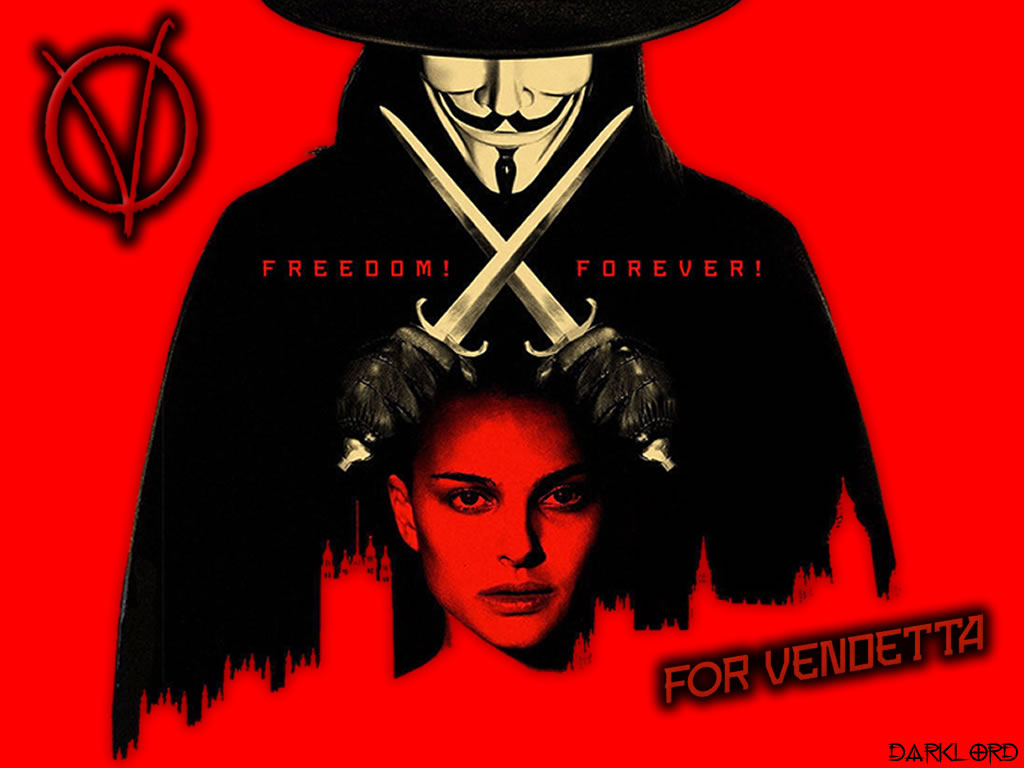
In V for Vendetta, the effect is similar. V is limitless; he kills people to bring about his goal of tearing society to the ground. Evey is upset when she sees the extremes he's willing to go to. It's a moral transgression for her, and for us, the readers. After they murder Bishop Lilliman she tells V, “I didn’t know you were going to kill someone. Killing is wrong.” V’s early work in the graphic novel is to persuade Evey to rebuild society after he destroys it. V needs to convince Evey, a societal insider, that society is sick and in need of recovery.


V is the result of the destruction of his natural self. Whoever he was before he became V was destroyed at Larkhill, creating an alternate persona who is quite possibly a sociopath; we never know a single thing about the man he was before. V kills when he needs to, and he forgoes any limitations his prior self might have had.

His purpose is to tear down society: “Anarchy wears two faces, both Creator and Destroyer. Thus Destroyers topple empires; make a canvas of clean rubble where creators can then build a better world.” He needs to take radical action to enlist Evey’s help and show her the illness of society, because her role is that of the creator.

Joe, in Fight Club, is complacent and doesn’t see the need for rebellion either. Palahniuk achieves Joe's transformation through self-destruction and re-creation. In contrast to V’s rebirth story, Joe’s transformation is indirect; it is represented by the demolition of his condominium. The condo is symbolic of the narrator himself and his mediocre, unsatisfying life. He explains to the detective in his free indirect dialogue, “That was my whole life. Everything, the lamps, the chairs, the rugs were me... It was me that blew up. Couldn’t he see that?” When Joe destroys the condo, he destroys part of himself, and part of him becomes Tyler. 


In V for Vendetta, the rebel outsider says of himself, “There's no flesh or blood within this cloak to kill. There's only an idea. Ideas are bulletproof.” According to V, Tyler is indestructible because he too is an idea. Although the narrator eventually eliminates Tyler, he has removed Tyler’s real-world agency, not the scope of his rebellious ideology. The end of Fight Club signals the survival of Project Mayhem and Tyler’s spirit in the thoughts and actions of the surviving members of Project Mayhem. When the narrator is brought his lunch tray in the asylum he is told, “We miss you Mr. Durden,” and “Everything’s going according to plan.” Tyler Durden is an indestructible outsider figure, and Joe, as an insider, can’t have his rebellion without him.


Before Tyler, Joe isn’t crazy, but he is trapped by his Ikea catalogue addiction and his filing cabinet condominium lifestyle. Tyler tells Joe, “The liberator who destroys my property... is fighting to save my spirit.” Tyler is the crazy part of Joe that can easily destroy material possessions, or blow things up, which is a very extreme act of rebellion. He is the part of Joe responsible for blowing up the condo. Tyler is the outsider who has to commit extreme transgressions to show Joe his perception of society, and he is also without limitations in his actions.

The relationship between V and Evey functions differently than that of Tyler and Joe, but it is still an outsider-insider counterpart relationship. The largest difference is that Evey is indoctrinated into V’s thinking, and essentially becomes him, but she does not go crazy. V is has no limits, and his role is to destroy society. Evey’s function is to rebuild it. V tells her, “This is not anarchy, Eve. This is chaos.” Chaos is V’s construction, and it is up to his converted Evey to bring about anarchy, a positive political ideology built, for Moore, around Love. Still, Evey does symbolically merge selfs with V when she puts on his Guy Fawks mask and costume.

There are many times when the insider challenges the rebellious ideology. Tyler is not worried about hurting people, and he has no reservations about killing. He tells the members of the Assault Committee, “And just so you don’t worry about it, yes, you’re going to have to kill someone.” This example is an instance where the narrator is quite separate from his insane leader and alternate personality, because his response is: “No questions... The fifth rule about Project Mayhem is you have to trust Tyler” (93), but he continually questions Tyler immediately afterwards, starting in the next chapter when Tyler says he wants seventy-two copies of his list of notes and the narrator replies, “Why that many?” At this point, the reader and the narrator are at the same level of challenging and questioning Tyler’s outsider extremism, but that all flies out the window when Tyler and Joe turn out to be one and the same.

The insider and the outsider in fact the same person. When Joe asks Marla what his name is,  she replies, “Tyler Durden. Your name is Tyler Butt-Wipe-for-Brains Durden” (great line, by the way). In the confrontation between Joe and his alternate persona, Tyler even admits to being insane: “Every time you fall asleep... I run off and do something wild, something crazy, something completely out of my mind,” which is of course, also Joe’s mind. Palahniuk achieves a rebellion in his novel by merging Tyler Durden, a figure who is both crazy and extreme, with the narrator persona, who at first appears to be an insider and needs to be convinced that society has failed him.

Therefore, when the two merge, the narrator’s insanity is a projection of society’s insanity, because he is both an insider and an outsider. If the character that was a societal insider through much of the text is in fact crazy, then society itself is insane.

The narrator is an especially relatable insider in scenes in which he downplays Tyler’s extremist ideology, for example when he doesn’t take the personal burial money for Project Mayhem very seriously. He is to keep $500 in his shoes, and there is vodka in the house for soap-making, but the narrator says, “I steal a bottle of vodka and spend my personal burial money on cigarettes.” With this small action, he is dissenting from Tyler’s over-the-top ideology.


Even when the narrator does something as extreme and immoral as holding Raymond Hessel at gunpoint, Tyler’s extremism is behind it all: “This is what Tyler wants me to do. These are Tyler’s words coming out of my mouth.” The narrator removes his own agency from anything he does that would alienate the reader, because as long as he is separate from Tyler, he is the insider and Tyler is the crazy outsider who has yet to prove to him that society itself is nuts. The rebels of V for Vendetta and Fight Club may be insane, but their psychosis is a projection of the insanity of a society that is complacent with mediocrity. 

When V says, “Happiness is a prison, Evey. Happiness is the most insidious prison of all” (Moore), he is talking about the complacency of society that keeps people from rebelling when their freedoms are being restrained. V succeeded in converting his insider counterpart. He says, “I didn't put you in a prison, Evey. I just showed you the bars.” Although she may disagree at first, in the end it seems as if that is exactly what he achieved, and it is his sane counterpart who goes to the extreme of pulling the lever that sends the explosives to blow up parliament.


Evey becomes as extremist as V was, and while wearing his mask, she admits that his outsider perspective on society was correct. If the insider can come to agree with the insane outsider, the definition of insanity is called into question. If both the outsider and his counterpart are crazy, it follows that society as a whole is nonsensical or insane. When Evey sends V on his viking funeral, she says, “You saw, and seeing, dared to do.” V was one of the only characters to see that society needed to be rebuilt, and his lack of limitations, due to his insanity, allowed him to act, and to change things, even if it required death and destruction.


The mentally ill look in on society from a different vantage point than the rest of us. The powers that insane rebel figures have include that outside perspective, and and the lack of limitations with which they make change. Both V and the Fight Club narrator destroy themselves and rebuild a new, almost inhuman persona with which to challenge society. Evey and Joe represent societal insiders who do not see reality from an outside perspective, where V and Tyler Durden reveal to them extreme, counter-cultural, rebellious ideologies.

Insanity separates V and Tyler Durden from everyone who is complacent with an unfulfilling and restrained existence in the fictional worlds of V for Vendetta and Fight Club. The narrator of Fight Club is almost relatable until it is revealed that he is crazy, and that he and Tyler Durden, a character who quickly goes well beyond the reader’s limits, are the same person. In V for Vendetta, Evey is a rebel who works within limits that are more reasonable than V’s; he, like Tyler, has the power to be limitless. The insane rebel has a sane counterpart, which is a projection of society’s mental illness, because the crazy outsider becomes the same person as the societal insider. Rebellion springs from the merging of the normal and the insane.